DALI-2 DT8 Tunable White LED Downlight for Commercial Projects: A Professional 20W/40W Lighting Solution 2026
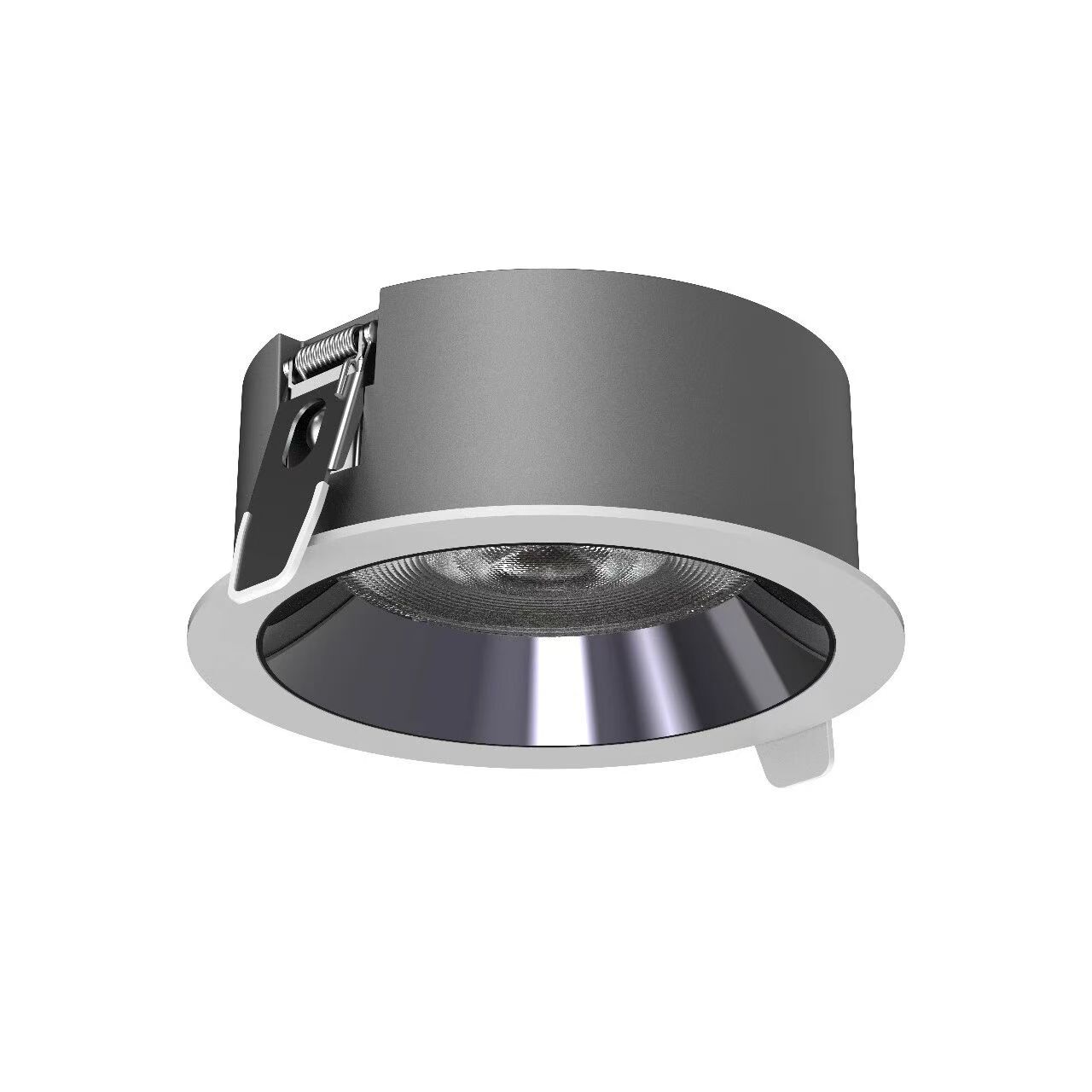
The Pustlux Professional High-CRI DALI-2 DT8 Tunable White LED Downlight is designed for commercial lighting applications that require adjustable white light and digital lighting control.
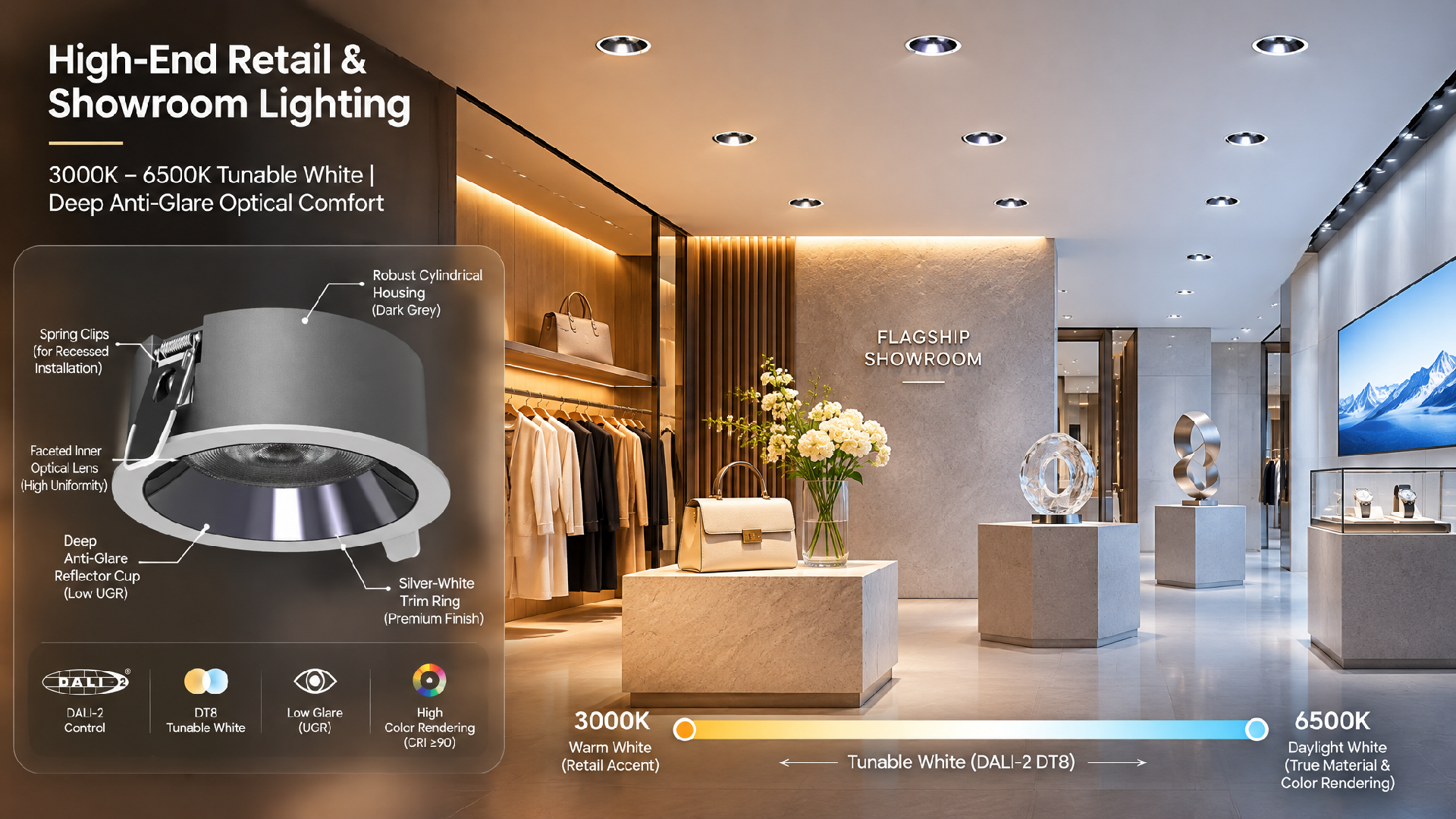
This guide explains how to specify tunable white LED downlights for commercial projects, how to select between 20W and 40W models, and what project teams should verify before installation and procurement.
Lighting requirements are rarely identical throughout a commercial building.
Different spaces have different visual tasks, operating schedules, architectural characteristics, and atmosphere requirements. A hotel reception area, office meeting room, retail store, and restaurant may all require different lighting conditions.
Traditional LED downlights usually provide one fixed colour temperature, such as 3000K or 4000K. Once installed, changing the CCT generally requires replacing the fixture or using a different product configuration.
A tunable white LED downlight provides greater flexibility by allowing the white light to be adjusted within a defined CCT range.
For commercial projects, this can support several practical requirements.
1.1 Adapt Lighting to Different Functional Areas
A commercial building may contain multiple functional zones.
For example:
| Projeect area | typical lighting objective | potential CCT preference |
|---|
| Hotel reception | Welcoming and comfortable atmosphere | Warm to neutral white |
| Hotel corridors | Comfortable general illumination | Warm white |
| Office work areas | Clear visual environment | Neutral white |
| Meeting rooms | Flexible lighting for different activities | Adjustable white |
| Retail stores | Merchandise presentation | Warm to neutral white |
| Restaurants | Comfortable dining atmosphere | Warm white |
| Exhibition spaces | Controlled presentation of displayed objects | Project-specific |
The actual CCT should be determined by the lighting designer according to the architectural concept, visual tasks, and applicable project requirements.
The Pustlux downlight's two CCT configurations provide different levels of adjustment flexibility.
The 2700K–4000K version is suitable for projects focused on warm-to-neutral white lighting. The 2700K–6500K version offers a wider adjustment range for projects requiring access to cooler white settings.
1.2 Reduce Dependence on Fixed-CCT Fixtures
For projects with multiple functional areas, specifying separate fixed-CCT products may increase the number of product variants required.
A tunable white downlight can provide adjustable CCT within one luminaire configuration, provided the correct driver and control system are specified.
This can simplify certain aspects of product scheduling and procurement.
However, tunable white should not automatically be treated as a replacement for every fixed-CCT fixture. The project team should evaluate the required adjustment range, control strategy, fixture cost, and operating requirements before making a final decision.
1.3 Support Lighting Scene Management
Commercial buildings often operate according to different schedules.
A hotel may require different lighting scenes for daytime reception, evening hospitality, and special events. An office may use different scenes for meetings, presentations, and general working conditions.
With compatible DALI-2 DT8 control equipment, tunable white downlights can be integrated into a digital lighting control system to adjust brightness and colour temperature.
This provides project teams with greater flexibility after installation, without relying exclusively on manually selected fixed-CCT settings.
2. Understanding DALI-2 DT8 Tunable White Control in Project Lighting Applications
For professional lighting projects, the control system is as important as the luminaire itself.
DALI-2 is a digital lighting control framework used in commercial and architectural lighting applications. It allows compatible lighting devices to communicate with a control system through a digital interface.
DT8 refers to Device Type 8, which covers colour-control equipment. For tunable white applications, the relevant functionality is generally DT8, which supports colour-temperature control.
2.1 What Can DALI-2 DT8 Control?
When the downlight is equipped with a compatible DALI-2 DT8 dimming driver and connected to a compatible control system, the lighting system can support:
Brightness adjustment.
Colour temperature adjustment.
Programmable lighting scenes.
Centralised control of compatible luminaires.
Integration into coordinated commercial lighting control strategies.
For example, a hotel reception area may use a warmer CCT setting in the evening and a more neutral setting during daytime operations.
A meeting room may use different brightness and colour-temperature settings depending on whether the room is being used for presentations, discussions, or general activities.
The exact functions depend on the installed driver, DALI control equipment, commissioning configuration, and control software.
2.2 Consider DALI Integration During the Design Stage
DALI control should be considered early in the project rather than treated as an additional feature after the luminaires have been selected.
The lighting designer and electrical contractor should coordinate:
The required control zones.
The number of luminaires on each control line.
The driver and control-system compatibility.
The intended CCT adjustment range.
The required lighting scenes.
The commissioning and handover process.
Early coordination can help reduce compatibility problems and unnecessary changes during installation.
3. High CRI 92: Colour Quality for Professional Commercial Lighting Environments
Colour quality is an important consideration in commercial lighting design, particularly in environments where products, materials, artwork, or interior finishes need to be presented accurately.
The Pustlux tunable white LED downlight has a stated CRI of 92.
CRI, or Colour Rendering Index, is a measurement used to evaluate how accurately a light source renders colours compared with a reference illuminant under defined conditions.
A CRI specification of 92 positions the product for applications where colour rendering is an important selection criterion.
In retail environments, lighting directly affects how customers see merchandise.
Clothing, cosmetics, furniture, flooring, decorative materials, and other products may appear different under light sources with different colour-rendering characteristics.
High-CRI lighting helps maintain a more accurate visual presentation of merchandise.
For retail development projects and commercial showrooms, CRI should therefore be considered alongside CCT, luminous flux, beam distribution, and glare control.
3.2 Hotels and Hospitality Buildings
Hotels use lighting to establish different visual atmospheres throughout the building.
Reception areas, restaurants, corridors, guest facilities, and meeting spaces may all have different lighting requirements.
A CRI 92 downlight can support applications where accurate colour presentation is important, particularly around interior finishes, furniture, decorative elements, and merchandise.
3.3 Offices and Public Buildings
In office and public-building projects, lighting design must balance visual comfort, functional requirements, and energy performance.
CRI 92 provides a high colour-rendering specification for spaces where colour appearance is relevant.
However, CRI should not be used as the only measure of lighting quality. Project teams should also review glare, illuminance, uniformity, flicker performance, colour consistency, and the relevant workplace lighting requirements.
3.4 What Other Colour-Quality Data Should Project Buyers Request?
For professional procurement, it is useful to request additional supporting data.
These may include:
R9 value.
CCT tolerance.
SDCM.
Spectral power distribution.
Colour consistency across production batches.
Photometric test reports.
The stated CRI 92 specification is a useful starting point, but project-specific requirements should be verified through the manufacturer's technical documentation.
Energy efficiency is a major consideration in commercial building development.
Lighting installations may contain hundreds or thousands of luminaires, operating for extended periods every day. Consequently, the efficiency of each fixture can contribute to the overall energy consumption of the lighting installation.
The Pustlux tunable white LED downlight offers a stated luminous efficacy of 110 lm/W.
Luminous efficacy measures how much luminous flux a luminaire produces per watt of electrical input.
4.1 Why Does Luminous Efficacy Matter in Large Projects?
In a large commercial building, lighting energy consumption is affected by:
The total number of installed luminaires.
Rated input power.
Operating hours.
Lighting control strategy.
Required illuminance.
Daylight availability.
Occupancy and operating schedules.
A higher-efficacy luminaire can help reduce the electrical power needed to achieve a specified luminous output, provided that the optical distribution and installation layout meet the design requirements.
For project developers and building owners, the benefit should be evaluated at the complete lighting-system level rather than through the lm/W figure alone.
4.2 Lighting Controls and Operational Energy Management
The combination of efficient LED technology and digital lighting control can provide additional opportunities for managing lighting operation.
For example, a compatible DALI-2 control system may support scheduled dimming and lighting scenes.
When combined with suitable occupancy sensors, daylight sensors, and a properly designed control strategy, the lighting installation can respond more effectively to actual building usage.
The potential energy savings depend on the building design, operating conditions, control configuration, and commissioning quality. They should not be assumed from the luminaire's luminous efficacy alone.
Choosing the correct downlight wattage is an important part of commercial lighting design.
The Pustlux product range provides two power options: 20W and 40W.
They also have different product dimensions and ceiling cut-out requirements, making installation coordination essential.
5.1 20W LED Downlight: Compact Recessed Lighting for Commercial Interiors
The 20W model has the following specifications:
| Parameter | Specification |
|---|
| Rated power | 20W |
| Luminous efficiency | 110 lm/W |
| CRI | 92 |
| Product diameter | Ø150 mm |
| Product height | 44 mm |
| Ceiling cut-out | Ø115–130 mm |
| CCT options | 2700K–4000K / 2700K–6500K tunable white |
| Dimming Control | DALI-2 DT8 |
With a diameter of 150 mm and a height of 44 mm, this model is a potential option for projects where a smaller recessed fixture is required.
Typical applications may include:
The 20W model should be selected according to the required illuminance, fixture spacing, ceiling height, and photometric distribution.
5.2 40W LED Downlight: Higher-Output Recessed Lighting for Larger Areas
The 40W model provides a higher power option for projects requiring greater luminous output.
| Parameter | Specification |
|---|
| Rated power | 40W |
| Luminous efficiency | 110 lm/W |
| CRI | 92 |
| Product diameter | Ø180 mm |
| Product height | 52 mm |
| Ceiling cut-out | Ø160 mm |
| CCT options | 2700K–4000K / 2700K–6500K tunable white |
| Dimming Control | DALI-2 DT8 |
Its larger dimensions and higher power make it a potential choice for larger commercial interiors and applications requiring higher output.
Typical applications may include:
The actual number of luminaires required must be determined through lighting calculations and photometric simulation.
5.3 Comparison for Project Specification
| Selection factor | 20W model | 40W model |
|---|
| Power | 20W | 40W |
| Indicative luminous flux | 2,200 lm | 4,400 lm |
| Dimensions | Ø150 × H44 mm | Ø180 × H52 mm |
| Ceiling cut-out | Ø115–130 mm | Ø160 mm |
| CCT options | 2700K–4000K / 2700K–6500K tunable white | 2700K–4000K / 2700K–6500K tunable white |
| CRI | 92 | 92 |
| Luminous efficiency | 110 lm/W | 110 lm/W |
| Dimming Control | DALI-2 DT8 | DALI-2 DT8 |
The higher wattage model does not automatically mean it is suitable for every larger space. Ceiling height, beam angle, spacing, glare requirements, and the target illuminance must all be considered.
6. Installation Coordination: Ceiling Cut-Out and Recessed Mounting Requirements
Installation compatibility is particularly important in commercial projects, especially when the lighting specification is being developed after ceiling construction has already started.
Incorrect cut-out dimensions can cause installation delays, additional ceiling work, and coordination problems between the lighting supplier and site contractor.
The Pustlux downlight range has two different installation dimensions.
6.1 20W Model Installation Dimensions
The cut-out range should be checked against the actual installation conditions and product drawing before ceiling openings are prepared
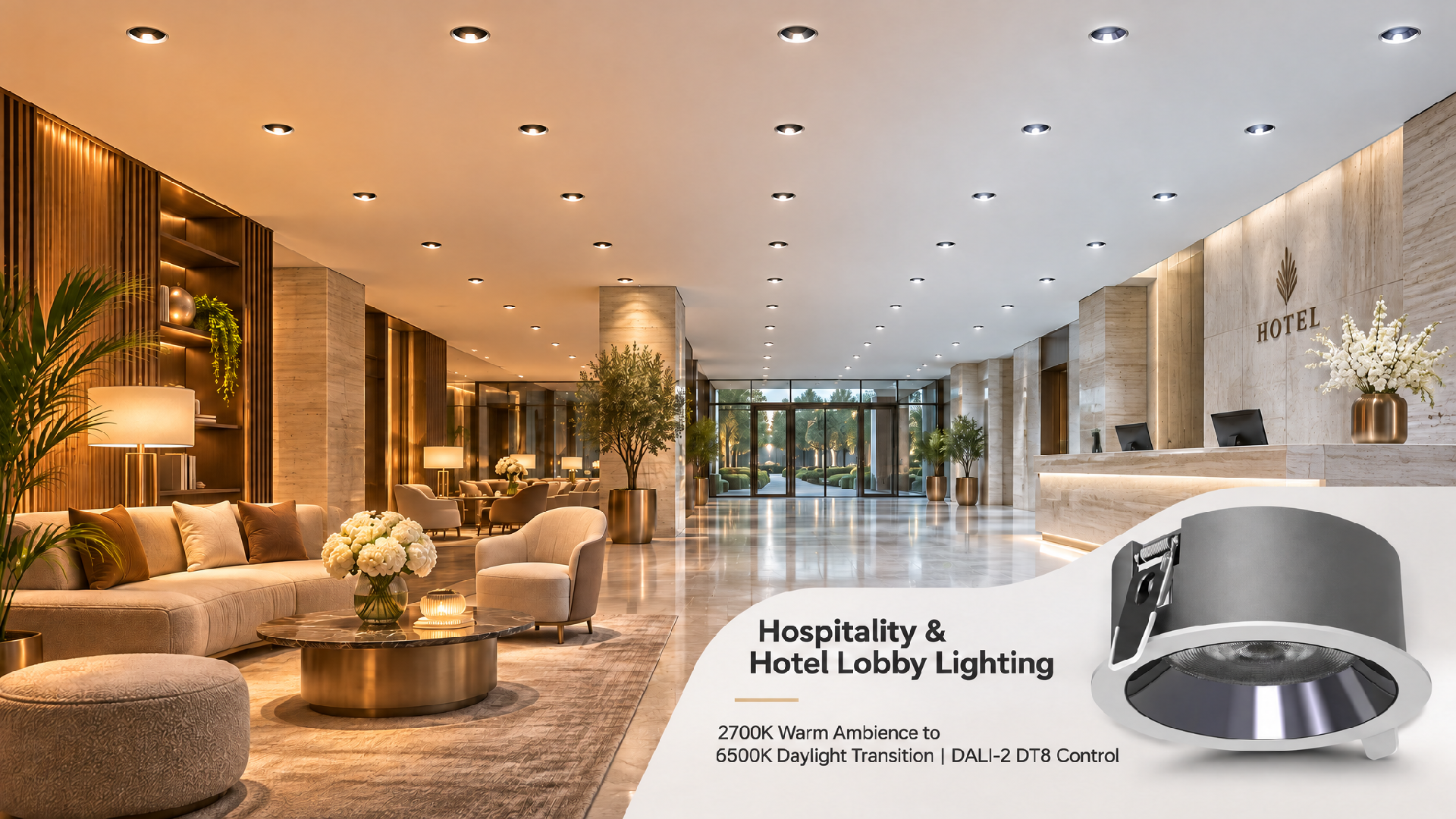
The combination of adjustable CCT, CRI 92, and digital lighting control makes tunable white downlights relevant to a range of commercial building types.
7.1 Hotel and Hospitality Projects
Hotel lighting design needs to accommodate different areas, activities, and operating periods.
Typical spaces include:
The 2700K–4000K version may be suitable for hotel environments that prioritise warm-to-neutral white lighting.
The 2700K–6500K version offers a wider adjustment range for projects with more varied CCT requirements.
DALI-2 DT8 control can help coordinate different lighting scenes across compatible control zones.
7.2 Office Buildings and Commercial Workspaces
Modern office buildings may require different lighting conditions for open-plan workspaces, meeting rooms, reception areas, and collaborative zones.
A tunable white downlight provides the ability to adjust white light according to the intended use of each area.
For office projects, the lighting designer should evaluate the relevant illuminance, uniformity, glare, colour quality, and energy requirements.
The 40W option may be considered for areas requiring higher luminous output, while the 20W option may be appropriate for other recessed lighting layouts.
Final selection should be based on photometric calculations rather than wattage alone.
7.3 Retail Development Projects
Retail lighting is closely related to merchandise presentation and customer experience.
A high-CRI downlight can help reveal merchandise colours more accurately, while tunable white control allows the lighting atmosphere to be adjusted.
The Pustlux CRI 92 downlight may be considered for:
The choice between the two CCT configurations should reflect the retail concept and the lighting designer's requirements.
7.4 Restaurant and Food-Service Projects
Restaurants, cafés, and food-service environments often require a balance between comfortable ambience and practical visibility.
The 2700K–4000K configuration offers a warm-to-neutral white adjustment range that can be considered for dining spaces.
For kitchens, service areas, and other functional zones, the project team should select the appropriate luminaire and CCT based on the actual task requirements and applicable hygiene and safety considerations.
7.5 Exhibition and Gallery Projects
High colour rendering is valuable in exhibition environments where accurate object appearance is important.
CRI 92 provides a useful colour-rendering specification for projects displaying artwork, products, decorative materials, or other visual exhibits.
However, exhibition lighting must also consider glare, illuminance, beam distribution, UV content, exposure duration, and material sensitivity.
The tunable white function provides additional flexibility, but the final lighting design must be tailored to the displayed objects and conservation requirements.
8. Project Procurement Checklist: What Should Buyers Confirm Before Ordering CCT tunable white LED downlights?
For importers, electrical contractors, lighting consultants, and project procurement managers, selecting a product requires more than reviewing a marketing specification.
The following checklist can help reduce technical and procurement risks.
8.1 Confirm the Product Configuration
Specify whether the project requires:
These details should be included in the lighting schedule and purchase order.
8.2 Request Technical Documentation
Before approving the product, request relevant documentation, such as:
Product datasheet.
Dimension drawing.
Photometric report.
Electrical specification.
Driver datasheet.
DALI-2 DT8 compatibility information.
Relevant safety and EMC documentation.
Applicable certification documents.
The exact documents required will depend on the project specification, destination market, and procurement requirements.
8.3 Verify Control-System Compatibility
For DALI-2 DT8 projects, verify the driver's actual control functionality.
The project team should confirm the required DT8 Tc operation and compatibility with the selected DALI control system.
Where possible, arrange a sample test with the intended control equipment before approving the complete order.
8.4 Review Sample Approval Requirements
Sample approval is an important step in commercial lighting procurement.
Before bulk production, the buyer may need to review:
A documented approval process can help ensure that the supplied products match the agreed project specification.
8.5 Coordinate Delivery and Project Schedule
Lighting products are often required according to construction milestones.
Project buyers should coordinate the order quantity, production lead time, sample approval, delivery schedule, and site installation programme with the manufacturer.
For larger developments, it may also be necessary to coordinate phased deliveries according to building zones or construction stages.
9. Why Work with a Professional LED Downlight Manufacturer for Commercial Lighting Projects?
A commercial lighting project involves multiple stakeholders and technical requirements.
Working with a manufacturer that understands product specifications, OEM requirements, and project procurement can help simplify the sourcing process.
Pust Lighting Company supplies professional LED lighting products under the Pustlux brand and provides OEM services for customers with specific sourcing and product requirements.
For commercial project buyers, cooperation with a manufacturer can support:
Product configuration discussions.
Technical specification confirmation.
Sample evaluation.
OEM product requirements.
Project quantity coordination.
Packaging and labelling discussions.
Production and delivery coordination.
For projects requiring DALI-2 DT8 tunable white downlights, the most important step is to confirm the complete luminaire and driver configuration before placing the order.
Project-specific documentation and compliance requirements should also be agreed upon during the technical approval stage.
10. FAQs About DALI-2 DT8 Tunable White LED Downlights for Projects Lighting
Q1. What is a DALI-2 DT8 tunable white LED downlight?
It is a recessed LED downlight that supports brightness and colour-temperature control through a compatible DALI-2 DT8 dimming colour-control system. For tunable white applications, the relevant control functionality is generally DT8.
Q2. What CCT ranges are available for the Pustlux downlight?
The product is available in two configurations: 2700K–4000K and 2700K–6500K tunable white. These are alternative configurations, and the required version should be specified when ordering.
Q3. What power options are available?
The Pustlux downlight is available in 20W and 40W models.
Q4. What are the dimensions and ceiling cut-outs?
The 20W model measures Ø150 × H44 mm and requires a ceiling cut-out of 115–130 mm.
The 40W model measures Ø180 × H52 mm and requires a ceiling cut-out of 160 mm.
Q5. What is the luminous efficacy of the product?
The stated luminous efficacy is 110 lm/W. Based on this figure, the indicative luminous flux is 2,200 lm for the 20W model and 4,400 lm for the 40W model. Actual output should be confirmed through the relevant photometric report.
Q6. Why is CRI 92 important for commercial lighting projects?
CRI 92 is a high colour-rendering specification that is relevant to environments where accurate colour presentation is important, including retail stores, showrooms, hotels, and exhibition spaces.
Q7. Can these downlights be integrated into a centralised lighting control system?
They are designed with DALI-2 DT8 Dimming control as a product feature. Integration into a particular project depends on the driver configuration, DALI control equipment, system compatibility, and commissioning.
Q8. What is the difference between 2700K–4000K and 2700K–6500K?
The 2700K–4000K version provides warm-to-neutral white adjustment. The 2700K–6500K version provides a wider adjustment range extending into cooler white settings.
The correct option depends on the intended building use and lighting design.
Q9. Can the 20W and 40W models be used in the same commercial project?
They can be considered for different areas of the same project, provided the lighting calculations, installation dimensions, control strategy, and project specifications support both models.
Q10. What should electrical contractors check before installation?
Contractors should verify the ceiling cut-out, installation depth, electrical connection, driver arrangement, DALI wiring, and control-system compatibility before installation.
Q11. What technical documents should project buyers request?
Typical documents include the product datasheet, dimension drawing, photometric report, driver datasheet, electrical specifications, and applicable certification and compliance documents.
The exact documentation depends on the project and destination market.
Q12. Does Pust Lighting Company provide OEM services?
Yes. OEM services are available in Pust Lighting Company. Importers, wholesalers, contractors, and project buyers can contact the manufacturer to discuss product configurations and project sourcing requirements.
Conclusion: Specify the Right Tunable White Downlight for Your Next Commercial Project Lighting
Selecting LED downlights for a commercial building requires a coordinated evaluation of lighting performance, colour quality, control-system compatibility, installation dimensions, and procurement requirements.
The Pustlux Professional High-CRI DALI-2 DT8 dimming 2700K-4000K Tunable White LED Downlight provides a specification designed for projects that require adjustable white lighting and digital control.
Its key features include:
20W and 40W power options.
110 lm/W stated luminous efficiency.
CRI 92.
2700K–4000K or 2700K–6500K CCT tunable white.
DALI-2 DT8 dimming control.
Two recessed installation sizes.
For hotel developments, office buildings, retail projects, restaurants, showrooms, and other commercial environments, these configurations provide project teams with options for different lighting requirements.
If you are an electrical contractor, lighting consultant, project developer, or commercial lighting distributor looking for a professional tunable white LED downlight, contact Pust Lighting Company to discuss your project specifications, sample requirements, and OEM options.
 Tel.+86 15013617190
 Email:info@pustlux.com