CCT Selectable Track Light: A Flexible LED Lighting Solution for Commercial Projects
A typical three-CCT configuration can provide 3000K, 4000K, and 5000K options within one fixture, covering warm, neutral, and cool white applications. When combined with switchable power, interchangeable beam angles, and appropriate dimming options, a single LED track light platform can support a wide range of commercial applications.
This guide explains how CCT selectable LED track lights work, where they are most useful, how they can help B2B buyers simplify product management, and what technical specifications should be evaluated before purchasing.

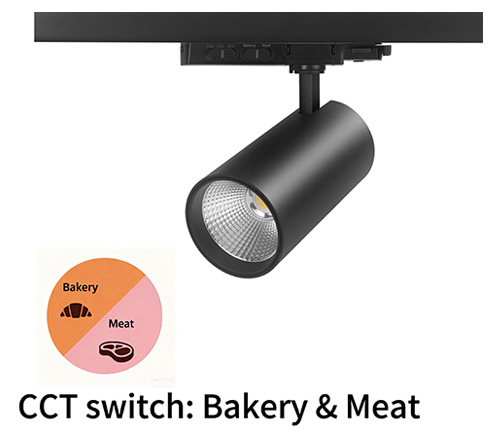
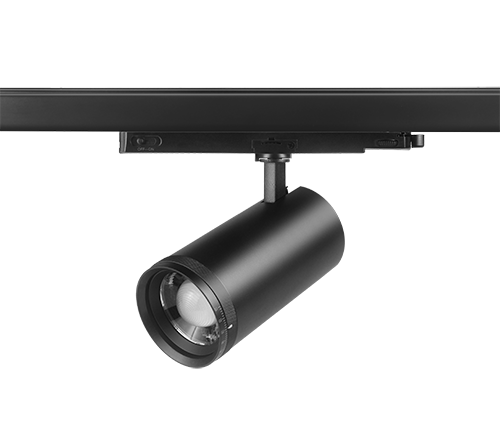
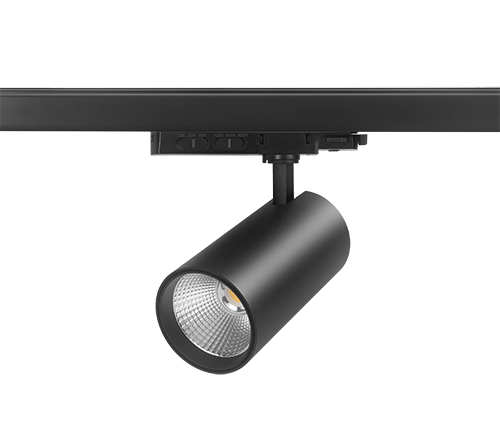
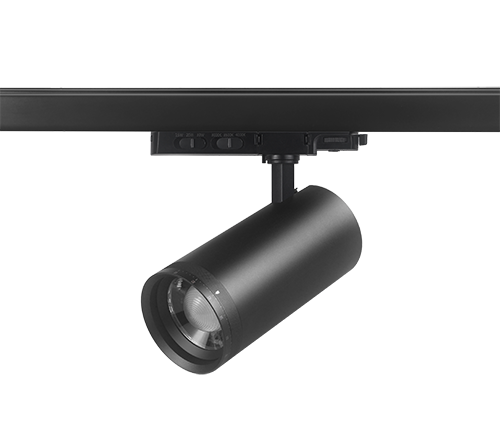
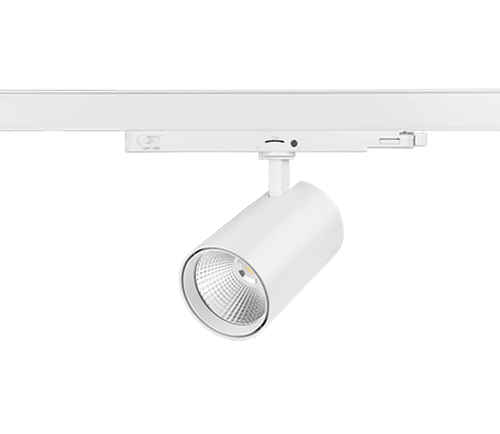
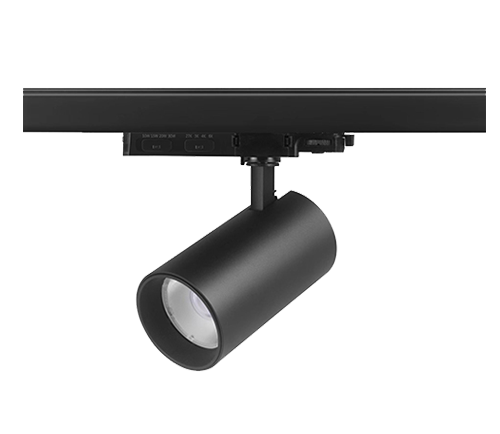
A CCT selectable track light is an LED track lighting fixture that allows the user to select different correlated color temperatures, or CCTs, from the same luminaire.
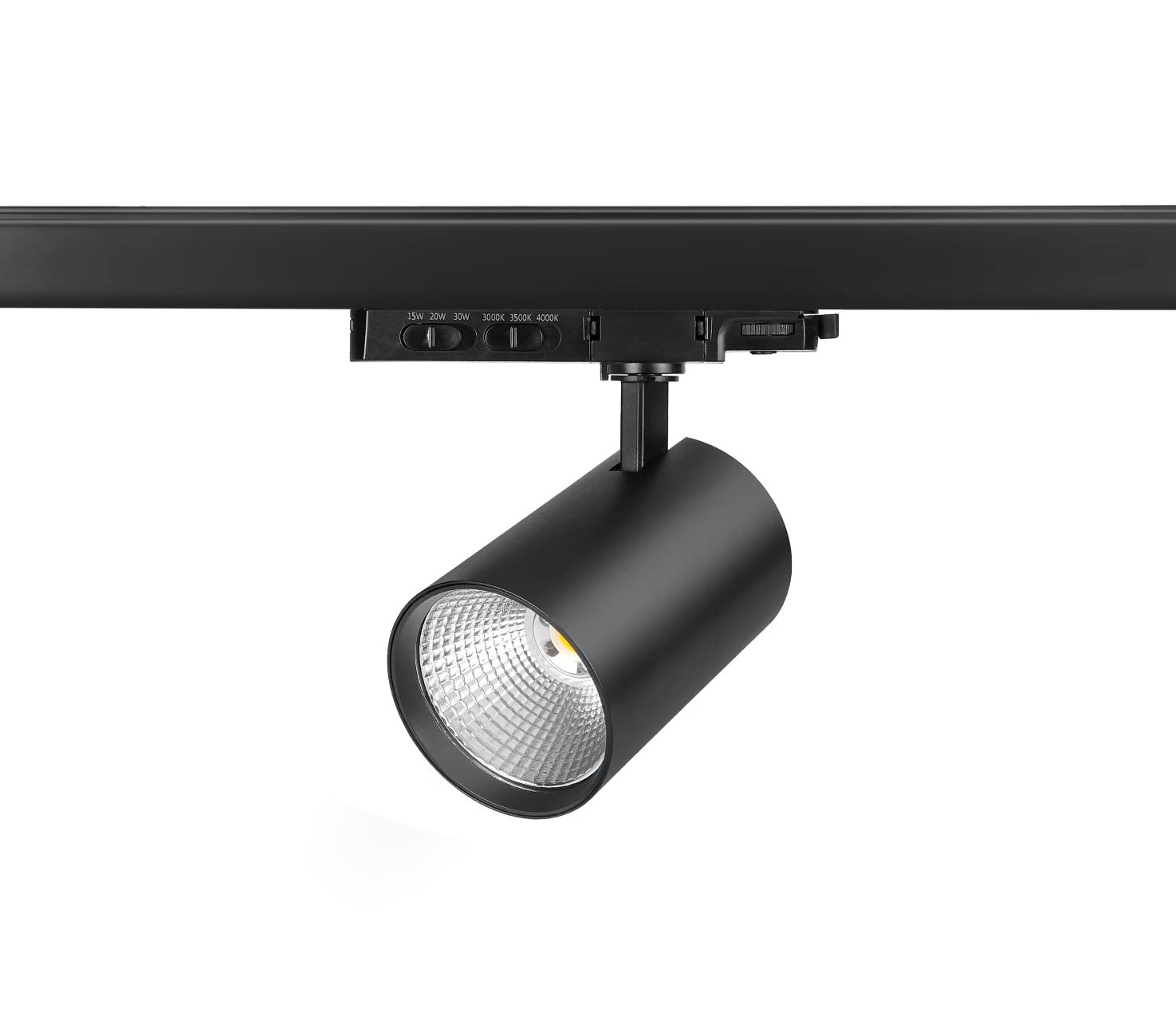
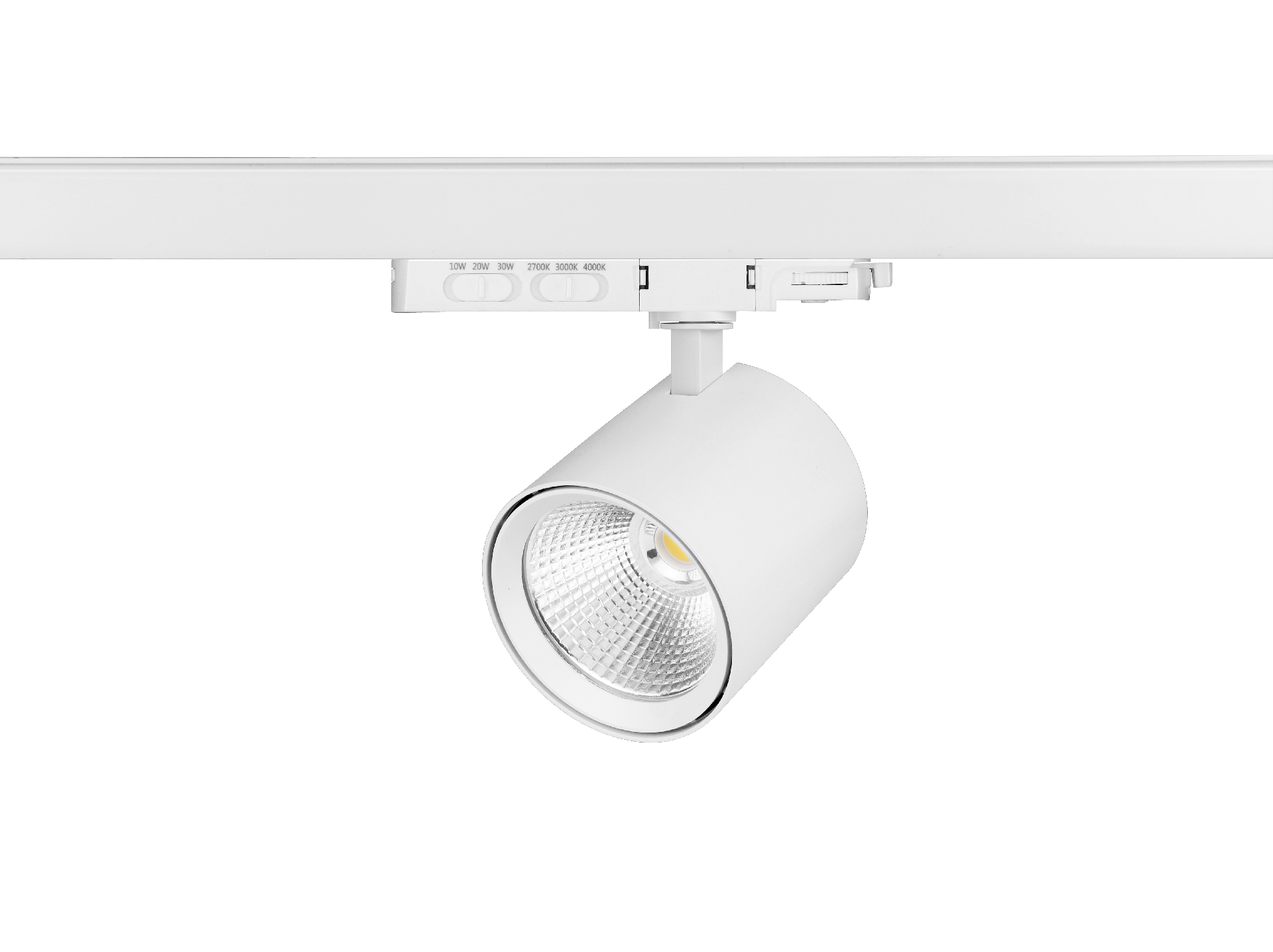
Instead of purchasing separate fixtures for different color temperatures, the lighting manufacturer integrates different LED chip configurations into one fixture and provides a selector switch. Depending on the product design, the CCT switch may be located on the track adapter, fixture housing, or another accessible position.
The principle is straightforward: one fixture can be configured for different lighting appearances according to the requirements of the space.
The actual CCT configuration should always be confirmed against the product datasheet because available options vary between models.
The key difference from a conventional fixed-CCT track light is therefore configuration flexibility. A fixed 3000K fixture remains 3000K after installation, while a CCT selectable fixture can be adjusted to another supported CCT when the project requires it.
Commercial lighting projects often change between the design, procurement, installation, and commissioning stages.
The interior materials may change. The merchandise may be different from the original specification. A tenant may request another lighting atmosphere. A contractor may discover that the selected CCT does not produce the expected visual effect after installation.
With fixed-CCT lighting, these changes may require replacement fixtures.
CCT selectable track lighting provides another option: make the final CCT selection after the fixture has been installed, provided the selected CCT is within the fixture's supported range.
This is particularly useful for retail and commercial projects because lighting is closely connected with product presentation, brand identity, interior materials, and customer experience.
The original article correctly identifies design flexibility as one of the major benefits of CCT-selectable lighting.
Retail lighting requires a balance between visual comfort, product presentation, color appearance, and brand atmosphere. There is no single CCT that is ideal for every retail environment.
3000K for Warm and Premium Retail Environments
3000K produces a warmer visual appearance and can work well in applications where the lighting design is intended to create a comfortable or premium atmosphere.
Potential applications include fashion boutiques, furniture stores, lifestyle retailers, hospitality-oriented commercial spaces, and selected jewelry environments.
For materials such as wood, leather, warm-toned fabrics, and certain interior finishes, a warmer CCT can complement the overall design.
4000K for Balanced Commercial Lighting
4000K provides a more neutral appearance and is a practical option for many general commercial environments.
It can be considered for retail stores, showrooms, supermarkets, electronics stores, and other spaces where a balanced white appearance is preferred.
5000K for a Cooler Commercial Appearance
5000K creates a cooler and brighter visual impression and can be considered for applications where a crisp appearance is preferred.
Potential applications include certain supermarkets, automotive environments, technical showrooms, and functional commercial areas.
However, CCT should not be selected based on a universal “best” value. The appropriate color temperature depends on the merchandise, interior design, brand positioning, surrounding materials, and lighting objectives.
4. How CCT Switchable Track Lighting Helps Reduce SKU Complexity and provides flexible lighting solutions
One of the strongest B2B advantages of CCT selectable LED track lights is the potential to simplify inventory.
For distributors and wholesalers, fixed-CCT products can create multiple product variants. If a distributor needs three wattages, three CCTs, and two housing colors, the product range can quickly expand.
If power is also selectable, the number of physical product variants may be reduced further, depending on how the manufacturer structures the product.
The important commercial point is not that CCT-selectable lighting automatically eliminates inventory. Rather, one physical fixture can cover multiple CCT requirements, which may allow distributors to simplify stocking strategies.
The original article highlights this SKU-consolidation concept as a major benefit for distributors and contractors.
Lower Inventory Complexity
Instead of forecasting demand for separate 3000K, 4000K, and 5000K models, a distributor may be able to stock a smaller number of selectable-CCT models.
This can simplify purchasing and product management.
Reduced Risk of Slow-Moving Variants
Demand for different CCTs may vary by market and application. A selectable-CCT product can provide greater flexibility when demand shifts between warm and neutral or cool white specifications.
This does not guarantee the elimination of dead stock, but it can reduce the number of separate fixed-CCT variants that need to be managed.
Easier Project Procurement
For contractors and project suppliers, one selectable-CCT model can potentially cover several customer requirements. This can make quotation, ordering, and project coordination more straightforward.
5. How 3CCT switchable Track Lights Reduce On-Site Lighting Risks for projects lighting
Lighting specifications can change during construction.
A project may originally specify 3000K, but after the fixtures are installed, the interior designer or end customer may prefer 4000K. With a conventional fixed-CCT fixture, changing the specification may require replacing the products.
With a CCT selectable track light, the final selection can be made using the integrated CCT selector, provided the required CCT is supported by the fixture.
This can help reduce situations where the lighting appearance needs to be changed after installation.
The original article identifies incorrect CCT selection as a potential source of reinstallation, shipping, and labor costs.
For project managers, the practical benefit is therefore greater installation flexibility and lower dependence on pre-installation CCT forecasting.
6. CCT adjustable track spot Lighting for Future Commercial Space Changes
Commercial properties often change over time.
Retail tenants may change their branding, merchandise, interior finishes, or customer experience strategy. Showrooms may be redesigned. Office layouts may be modified.
A fixed-CCT lighting system may become less suitable when the space changes.
A CCT selectable track lighting system gives property owners and tenants an additional adjustment option without necessarily replacing the complete lighting fixture.
For example, a commercial space originally designed around a warm 3000K environment could potentially be changed to 4000K when a new tenant requires a more neutral appearance.
This does not make the entire lighting system “future-proof” in every technical sense, but it does provide a useful level of future CCT flexibility.
The original article uses tenant turnover as an example of why adjustable CCT can be valuable in commercial real estate.
When evaluating a commercial CCT selectable track light, buyers should look beyond CCT alone.
Important parameters include wattage, lumen output, efficacy, CRI, SDCM, beam angle, input voltage, dimming method, track adapter, driver performance, thermal management, and applicable compliance documentation.
The following table consolidates the specifications presented in the original product information. Because product configurations can vary, model-specific values should be confirmed against the final datasheet.
Technical Parameter
| Specification | Importance for commercial projects |
| Watts | 15W-20W-30W | Supports different illumination requirements |
| 3CCT switchable | 2700K-3000K-4000K | Adapts lighting appearance to different applications |
Luminous Efficiency
| 100-110LM/W | Supports energy-efficient lighting deisgn |
| CRI | 90 | Stuiable for applications requiring good color rendering |
| Beam Angle | 15°/24°/36°60° | Supports different spotlighting and coverage requirements |
| Input Voltage | AC 220-240V | Suitable for application electrical systems |
| Power Factor | 0.9 | Relevant to electriacl system performance |
| Dimming | triac dimming/0-10v dimming/DALI2 dimming options | Enables integration with different control systems |
| Track Adapter | 3phase, 4 wire | Must match the specified track system |
| Compliance | CE, RoHS as applicable | Documentation should be confirmed for the exact model |
The original source provides these technical values, including CRI90, <3 SDCM, multiple beam angles, PF0.9, dimming options and 4-wire track configuration.
8. Why CRI and Color Consistency Matter in CCT Selectable Track Lighting
Changing CCT should not be the only consideration when evaluating a professional LED track light.
Color quality is equally important.
A commercial lighting project may use hundreds of fixtures, and noticeable differences between fixtures can negatively affect the visual consistency of the space. This is why specifications such as CRI and SDCM should be evaluated together with CCT.
A CRI 90 specification can be suitable for many retail and commercial applications where accurate product color representation is important.
Similarly, a specification of less than 3 SDCM indicates a relatively tight level of color consistency, although buyers should confirm the actual tolerance and measurement conditions in the manufacturer's technical documentation.
The original article emphasizes the relationship between CCT selection, CRI, and color consistency.
For higher-end applications such as galleries, museums, premium retail, or luxury showrooms, buyers should evaluate the complete color-quality specification rather than relying on CRI alone.
8.1 Beam Angle Selection for Commercial CCT Track Lighting
CCT determines the color appearance of the light, but beam angle determines how the light is distributed.
For commercial track lighting, the correct beam angle depends on the mounting height, target size, distance from the illuminated surface, and desired visual effect.
A narrow beam such as 15° can be useful when a concentrated spotlight effect is required. Medium beam angles such as 24° or 36° can provide a balance between focus and coverage. A wider 60° beam can illuminate a larger area.
Beam Angle
| General Lighting Effect | Typical use |
| 15° | Narrow and concentrated | Accent / feature lighting |
| 24° | Focused | Product displays |
| 36° | medium | Retail and showroom lighting |
| 60° | Wider coverage | General accent lighting |
The exact beam-angle availability is model-dependent and should be confirmed before specifying the product.
8.2 CCT Selectable Track Lights with Dimming and Smart Controls
Commercial lighting increasingly needs to work with lighting control systems rather than operating only through simple on/off switching.
Depending on the model, CCT selectable track lights may be available with different dimming technologies, including TRIAC, 0-10V, or DALI-2.
The correct driver should be selected according to the project's control system.
For retail stores, dimming can be used to adjust lighting levels for different areas or operating periods. In hospitality environments, controllable lighting can support different daytime and evening scenes. In showrooms, lighting levels can also be adjusted according to the desired visual presentation.
However, buyers should avoid assuming that every CCT selectable track light automatically supports every dimming protocol. CCT selection, dimming technology, driver configuration, and control compatibility should be confirmed as a complete system specification.
The original article discusses TRIAC, 0-10V, DALI-2 and Casambi as potential control options, but these should be treated as configuration-dependent rather than universal specifications.
9. How to Choose the Right CCT Selectable LED Track Light
For B2B buyers, choosing a CCT selectable track light should begin with the application rather than the product catalogue.
Step 1 — Define the Lighting Application
Determine whether the fixture will be used for general retail lighting, product highlighting, showroom lighting, gallery lighting, hospitality, office environments, or another application.
Step 2 — Select the Required CCT Range
Determine whether the project requires warm, neutral, cool, or multiple CCT options. A 3000K/4000K/5000K configuration can cover a broad range of commercial applications.
Step 3 — Evaluate Lumen Output and Wattage
Wattage alone does not determine lighting performance. Buyers should compare actual lumen output, efficacy, mounting height, fixture spacing, and target illuminance.
Step 4 — Select CRI and Color Consistency
For retail and display environments, evaluate CRI and SDCM requirements according to the merchandise and project specification.
Step 5 — Select Beam Angle
Choose the optical distribution based on the target area and mounting conditions rather than selecting the widest or narrowest beam by default.
Step 6 — Confirm Dimming and Track Compatibility
If the project uses TRIAC, 0-10V, DALI-2, or another control system, confirm driver compatibility before placing the order. The track adapter must also match the installed track system.
Step 7 — Request Complete Technical Documentation
For professional projects, request the manufacturer's datasheet, photometric files, driver information, compliance documentation, warranty terms, and sample before finalizing the specification.
10. Why CCT Selectable Track Lights Are Valuable for B2B Distributors
For lighting distributors and wholesalers, the value of a CCT selectable track light extends beyond the end user's lighting experience.
A multi-CCT product can potentially simplify product portfolios by allowing one physical model to serve several CCT requirements.
This can make it easier to:
Build a simpler product catalogue
Reduce duplicated CCT variants
Manage purchasing
Support multiple customer applications
Respond to project changes
Reduce the risk of ordering the wrong fixed-CCT version
Offer a more flexible commercial lighting solution
The commercial benefit should always be evaluated using the distributor's actual sales mix and inventory structure. A switchable product is not automatically more profitable, but it can provide a more efficient way to cover multiple lighting requirements.
11. CCT Selectable Track Light for European Commercial Projects
European commercial lighting buyers typically need to evaluate not only lighting performance but also product documentation, electrical compatibility, applicable regulatory requirements, and supplier reliability.
For importers and distributors, a professional supplier should be able to provide clear product specifications and relevant compliance documentation for the exact model and configuration being purchased.
Important documentation may include:
Product datasheet
Photometric data
Driver specifications
Applicable CE documentation
RoHS documentation
Warranty terms
Installation instructions
Packaging information
OEM/ODM specifications where applicable
Rather than treating certification logos as a substitute for technical verification, buyers should confirm that the documentation corresponds to the exact product configuration and intended market.
Frequently Asked Questions About CCT Selectable Track Lights
H3: What is a CCT selectable track light?
A CCT selectable track light is an LED track light that allows users to choose between multiple supported color temperatures from the same fixture, such as 3000K, 4000K, and 5000K.
H3: What are the main benefits of CCT selectable track lighting?
The main benefits are greater CCT flexibility, easier project adjustment, potential SKU simplification, and the ability to adapt the lighting appearance to different commercial applications.
H3: Does changing CCT significantly reduce lumen output?
Lumen output can vary between different CCT settings depending on LED configuration and driver design. Buyers should therefore use the manufacturer's measured photometric data for each CCT rather than assuming identical lumen output across all settings.
H3: Can CCT selectable track lights reduce inventory?
They can potentially reduce the number of separate fixed-CCT product variants that a distributor needs to stock. The actual inventory benefit depends on the product configuration and the distributor's purchasing strategy.
H3: Are CCT selectable track lights suitable for retail stores?
Yes. They can be useful for retail stores because different merchandise categories and interior designs may require different lighting appearances. The appropriate CCT should be selected according to the specific retail application.
H3: Can CCT selectable track lights be dimmed?
Some models are available with dimming options such as TRIAC, 0-10V, or DALI-2. Dimming compatibility is model- and driver-dependent and should be confirmed before ordering.
H3: Can CCT selectable track lights be used in galleries and museums?
They can be considered for these applications when the selected model meets the required color rendering, color consistency, optical, flicker, and conservation-related specifications. High-end museum lighting should be specified according to the project's lighting and conservation requirements.
H3: What CCT is best for retail stores?
There is no universal best CCT. 3000K can provide a warmer appearance, 4000K offers a neutral commercial appearance, and 5000K provides a cooler appearance. The appropriate selection depends on the merchandise and design concept.
H3: What should B2B buyers check before ordering?
Buyers should check wattage, lumen output, CCT range, CRI, SDCM, beam angle, driver, dimming compatibility, track adapter, input voltage, product dimensions, photometric data, applicable compliance documents, MOQ, lead time, warranty terms, and OEM/ODM capability.
Conclusion: Why CCT Selectable Track Lighting Is a Practical Commercial Solution
CCT selectable track lighting addresses an important challenge in modern commercial projects: lighting requirements can change between design, installation, commissioning, and future renovation.
By integrating multiple CCT options into one LED track light platform, manufacturers can provide greater flexibility for retail stores, showrooms, commercial spaces, and other applications.
For end users, the main advantage is the ability to select an appropriate lighting appearance. For contractors, it can provide greater flexibility during installation. For distributors, a selectable-CCT platform may simplify product management by reducing dependence on multiple fixed-CCT variants.
The most important point is that CCT should never be evaluated in isolation. Wattage, lumen output, beam angle, CRI, SDCM, driver performance, dimming compatibility, track type, and compliance documentation all contribute to the suitability of an LED track light for a commercial project.
For B2B buyers looking for a flexible commercial lighting platform, CCT selectable LED track lights can provide a practical balance between lighting flexibility and product standardization.
If you are sourcing CCT selectable track lights from China for retail, showroom, commercial, or distribution projects, contact Pust Lighting Company for product datasheets, samples, OEM/ODM options, MOQ, and project quotations.
 Tel.+86 15013617190
 Email:info@pustlux.com